
Products
Search
Categories
‹
›
‹
›
Description
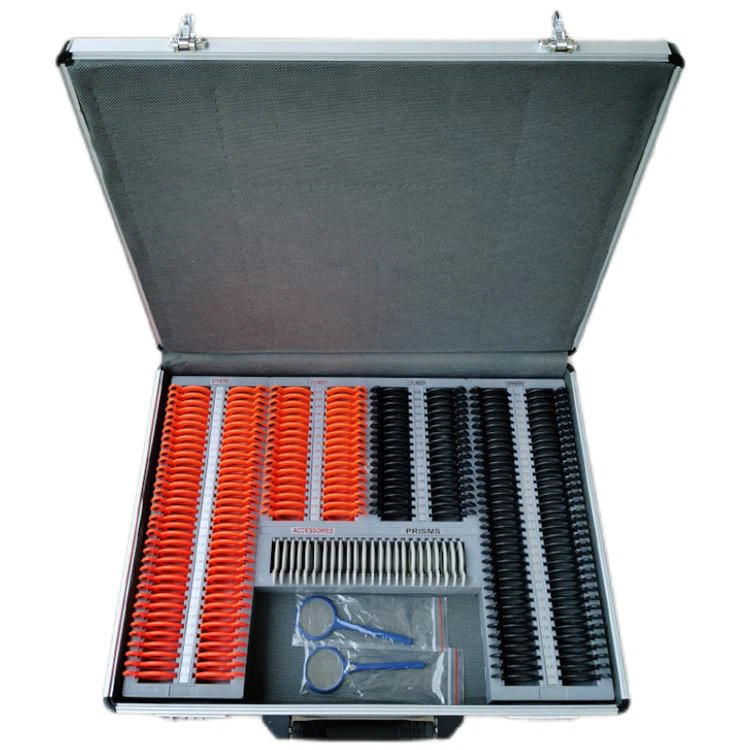
SL-232B 232 TRIAL LENS KIT
The reduced aperture trial lenses included in this set have a diameter of 26mm. The set consists of 232 pieces, each with accurate power degrees and flawless appearance finish.
Power marks are printed on each handle, making them easy to distinguish. The handle's degree is sprayed on one side, enhancing convenience during use and inspection.
Axis marks for cylinder and prism are directly engraved on the mirror surface, ensuring the axis position never changes.
The set comes with a standard removable plastic tray featuring bright silver-colored labels. The 232-piece trial lens kit is one of the most popular models among all trial lens sets.
What is Trial Lens Kit?
The Trial Lens Kit is a versatile and indispensable tool for optometrists and ophthalmologists in accurately determining the correct prescription for their patients. This superior Trial Lens Kit provides you with crystal clear vision into each patient's eyes, enabling you to make accurate and informed decisions about their eye care. These lenses are made of high-quality materials that provide maximum clarity and incredible color accuracy. Trial Lens Kit is designed with convenience and accuracy in mind, giving you the ability to make precise refractive evaluations. These Trial Lens Kit top-of-the-line optical lenses are made from premium materials, providing superior clarity while being lightweight and durable.
The Trial Lens Kit is the perfect accessory for any optometrist or eye care professional. It provides a wide variety of lens powers and styles, so that you can easily find the best combination for your patients. The lenses are constructed with precise accuracy to ensure a reliable fit in any frames. With this Trial Lens Kit, you can quickly examine how different lenses affect your patient's vision without having to change frames each time.
What types of trial lens kits are there?
Sphere lens
The curved surface focuses all paraxial parallel rays to one point (usually called the virtual focus) and the dioptric power on all axes positions is the same. Spherical lens includes concave lens (-) and convex lens (+). The former is used to correct myopia and the latter hyperopia and presbyopia.
Cylinder lens
The curved surface forms a part of cylindrical lens and the dioptric power on all axes positions is not the same. After passing through the lens, the light beam focuses on a straight line (or a broken line). Cylindrical lens consists of concave (-) and convex (+) cylindrical lens. They are used to correct astigmatism.
Prism lens
The tangent plane of a prismatic lens is a cuneiform. After passing through the lens, the light beam bends to the bottom and the object shifts towards edges. This kind of lens is used to exam and correct strabismus or heterophoria as well as to train eye-muscle.
Occluder (BL)
This is an opaque lens used to cover the uninspected eye.
Cross lens (CL)
There are two mutual vertical lines on the plane lens, used for locating pupil's center and measuring intraocular distance.
Frosted lens (FL)
This is a semi-transparent cover lens and mainly used for babies or used outdoors to replace occluder.
Slit Lens (SS)
There is a slit in the center, which is the only way light beams can pass through. By rotating this lens in front of the patient's eye, astigmatism can be examined as your vision changes in better or in worse at a certain axis position. On the contrary, it proves no astigmatism if the patient's vision has not changed during the rotation.
Plano lens (PL)
Plano lens are transparent lens with no dioptric power. It is usually used to determine malingering blindness.
Color Lens (RF, GF)
This kind of lens has different colors, e.g. red, green, blue, yellow and dark brown and is used to examine color sensitivity.
Cross cylinder (Jacson cross cylinder, JCC)
This is a kind of lens with contrary dioptric power in two axis positions and can be used to examine the degree and axis position of the cylindrical lens when determining astigmatism.
When using, put the cross cylinder lens before cylindrical lens and make one of its axis positions overlap that of the cylindrical lens. Then overturn the cross cylinder lens, the axis will turn 90° and observe the change of vision. If the patient's vision has no change, the degree of cylindrical lens used can be considered as suitable.
To get the correct axis position, place the cross cylinder lens before the cylindrical lens and let the hand shank of cross cylinder lens point to primary axis of cylindrical lens, then overturn the cross cylinder lens and observe the differences of vision at the two axis positions. If vision on one position is better than on another one, the axis of cylindrical lens can be slightly turned to the direction of the "better position". Then test again by the above method until difference of vision at two positions can hardly be noticed by the patient.
Maddox lens (MR)
Maddox lens is made of glass rods that convert a light spot into a streak 90o from the axis of the rods. It is used to measure the strength of eye muscle and to examine latent and real strabismus.
Put the Maddox lens in front of one eye and have the patient watch with both eyes. If a light spot he/she observes with his/her bare eye is on the line formed by the Maddox lens, the patient has neither strabismus nor latent strabismus. Otherwise he/she has one of them. If the light spot is on either side of the vertical line, he has horizontal strabismus. If the light spot is above or below the horizontal line, he has vertical strabismus. Then the strabismus can be corrected by using a prism lens, which makes the light spot coincides with the line. The strength of the prism indicates the degree of latent or real strabismus in prism diopters.
Pin hole (PH)
In its center, there is a small hole, through which light beam penetrates to form an artificial pupil and it is used to improve diopter especially the astigmatism.
135°is used to inspect visional function, balance both eyes, and mix function.
45° is used to inspect latent strabismus, stereoscopic vision, unequal vision and so on.
Related Products
Specifications
Sphere:
Concave: 35 pairs
Convex: 35 pairs
0.12D
0.25D to 4.00D in 0.25D steps
4.50D to 7.50D in 0.50D steps
8.00D to 15.00D in 1.00D steps
16.00D to 20.00D in 2.00D steps
Cylinder:
Concave: 17 pairs
Convex: 17 pairs
0.12D
0.25D to 2.25D in 0.25D steps
2.50D to 4.50D in 0.50D steps
5.00D to 6.00D in 1.00D steps
Prism
0.50 (2), 1.00 (2), 2.00 (2), 3.00 (1), 4.00 (1), 5.00 (1), 6.00 (1), 8.00 (1), 10.00 (1)
Accessories: 12 pieces
Red lens (x1), Green lens (x1), Black lens (x1), Plane lens (x1), Maddox lens (x2), Slit lens (x1), Cross line lens (x2), Frosted lens (x1), Pinhole lens (x2)
Cross Cylinder: 0.25D
Related Products
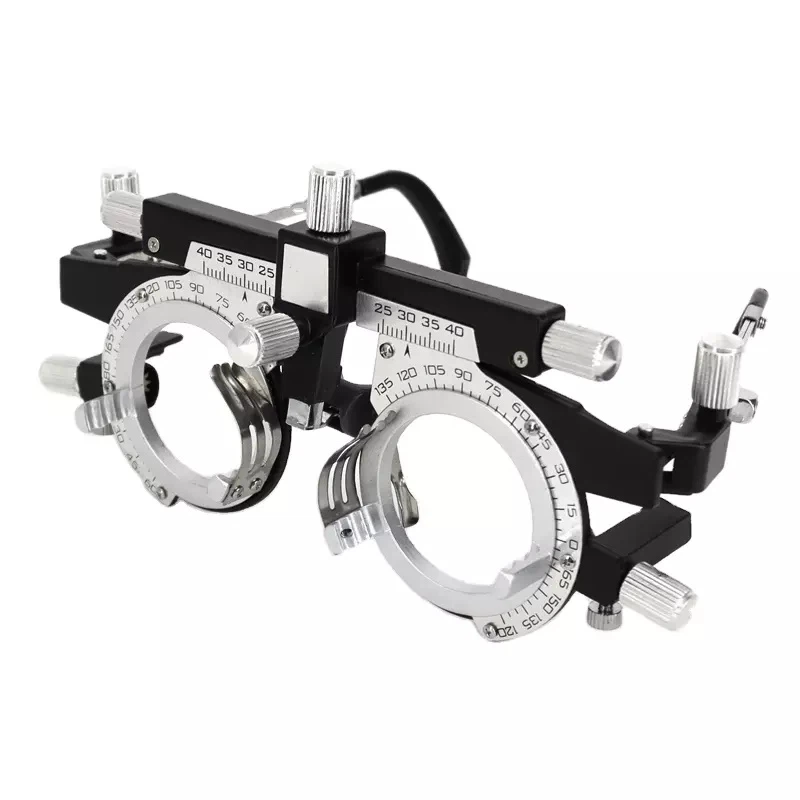
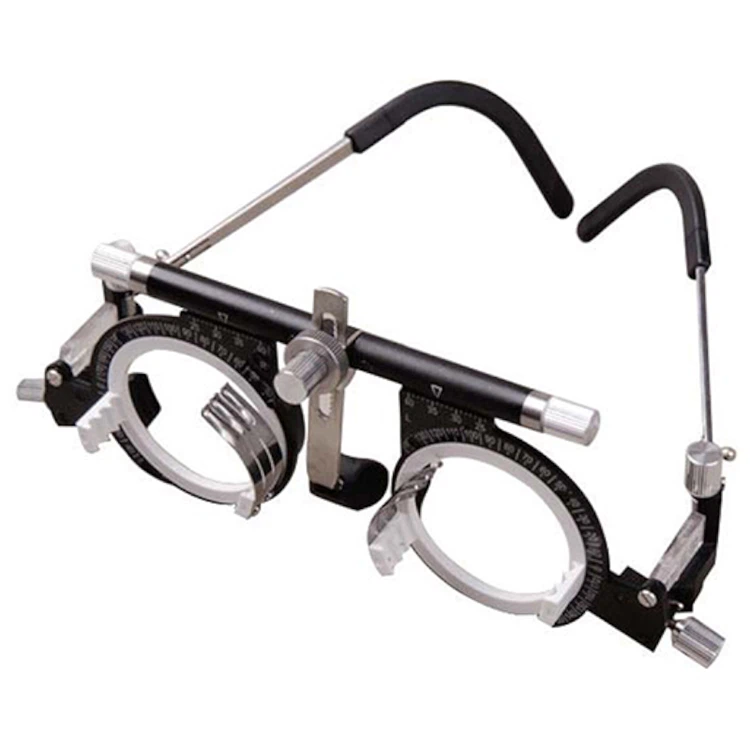
 Universal Optical Trial FrameThe Universal Optical Trial Frame is an essential tool for professionals in the field of optometry and ophthalmology. It is designed to accommodate various types of lenses, including sphere lenses, cylinder lenses, prism, and progressive lenses, making it suitable for patients with diverse visual needs.
 NoseAs one of the main features of this trial frame glasses is its lightweight design. This feature makes it easy to handle when some lenses are inserted in one frame, reducing the strain on the tested person’s nose, and avoiding the trial frame glasses from slipping off the bridge of the nose. The lightweight design also makes it suitable for both children or adults, ensuring that it can be used in various clinical settings.
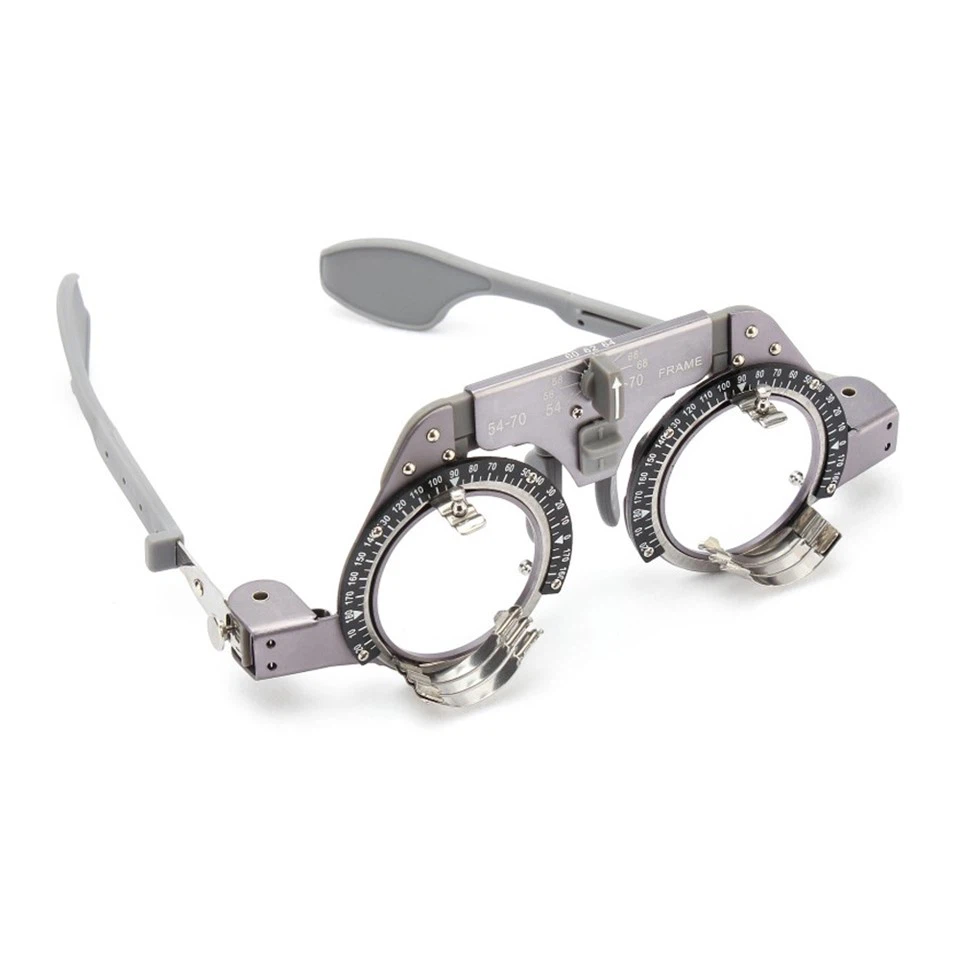
 Ophthalmic Trial FrameThe ophthalmic trial frame is an essential tool for optometrists and ophthalmologists during eye examinations. The TF-C ophthalmic trial frame is a high-quality and adjustable instrument suitable for a wide range of patients, from children to adults.
 232 Trial Lens KitThe reduced aperture trial lenses included in this set have a diameter of 26mm. The set consists of 232 pieces, each with accurate power degrees and a flawless appearance finish. Power marks are printed on each handle, making them easy to distinguish.
Get Your Free Quote Now!
Professional Service
Interested? Leave your contact details.
Search Starts Here


